


Radda in Chianti · since the X century
The thousand-year-old
cellar
One thousand square metres carved into history, built on the foundations of an ancient fortress and housing the wines of the Chianti Classico.
A history partly shrouded
in mystery
The origins of Castelvecchi date back to the X–XI century, documented in ancient early-medieval records known as the Carte dei Capitani di parte guelfa, in which the estate was already referred to as “Castello et Curtis” — evidence of its military function and the presence of a court.
What today houses the barrels and wines of the Chianti Classico was, a millennium ago, the defensive structure of a castle. The stones still speak.
Ten centuries
in five moments
Castello et Curtis
The earliest documented records place Castelvecchi as a military fortress and court. Its proximity to the Pieve di Santa Maria Novella — a property of the Holy See — made it a contested site, the target of attacks by the vassals of Monterinaldi.
Under the protection of the Holy See
Following conflicts with the vassals of Monterinaldi, the estate declared itself autonomous and submitted solely to the defence and control of the Holy See — a “garantigia” that granted it a unique standing within the medieval Chianti landscape.
The birth of the Fattoria
With the final dissolution of the Ancient League of Chianti — decreed by Grand Duke Pietro Leopoldo of Lorraine — the modern agricultural history of the Fattoria Castelvecchi begins. Don Urbano dè Vecchi reorganises the estate: he builds the new Villa, lays out the park and greatly extends the land. It is at this point that the name dè Vecchi becomes linked to the place for the first time, giving rise to the name Castel dè Vecchi, later Castelvecchi.
The ageing cellars
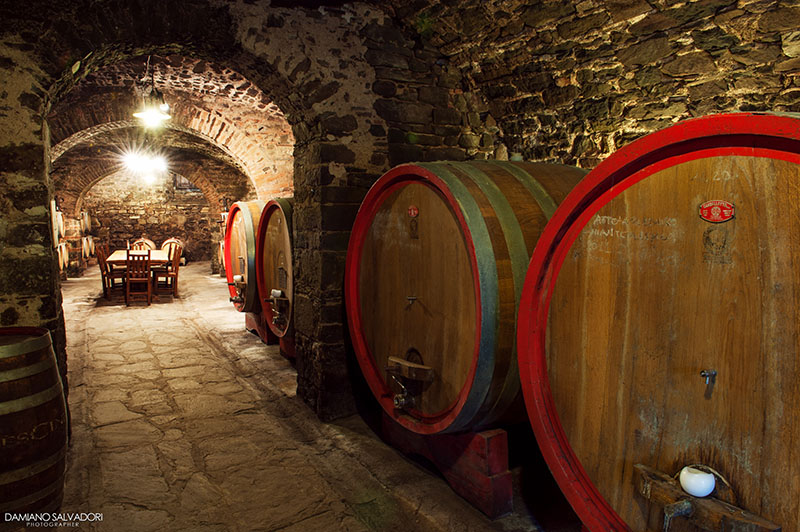
Don Urbano uses the foundations of a former military structure to build the ageing cellars — approximately 1,000 square metres of underground space. The original openings of the ancient fortress, still visible today in the museum corridor, bear silent witness to the defensive origins of these spaces.
The Chianti Classico Consortium
Abelardo Gutierrez de la Solana — a Spanish Grandee and heir of don Urbano — joined the newly founded Consorzio di produttori del Vino Chianti, today known as the Chianti Classico Consortium. An act that officially established Castelvecchi as a producer in the most prestigious wine zone of Tuscany.
Foundations of
an ancient fortress
The historic cellars of Castelvecchi extend across approximately 1,000 square metres of underground rooms, built upon the foundations of what was once a medieval defensive structure.
Walking through them, the original openings of the fortress are still visible in the museum corridor — narrow, deep, carefully oriented — a silent testimony to a purpose very different from today’s. Those same spaces now house the organic Chianti Classico wines produced for the guests of Castelvecchi.
Founding members of the
Chianti Classico Consortium
On 26 December 1930, Abelardo Gutierrez de la Solana — a Spanish Grandee and heir of the de Vecchi family — signed the deed of accession to the newly established Consorzio di produttori del Vino Chianti, today known as the Chianti Classico Consortium.
A gesture that reflected the far-sightedness of a family who, generation after generation, had transformed a medieval fortress into one of the historic estates at the heart of Chianti.
Come and discover it in person
The cellar is visited during the tasting experience. Book your place among the barrels.